
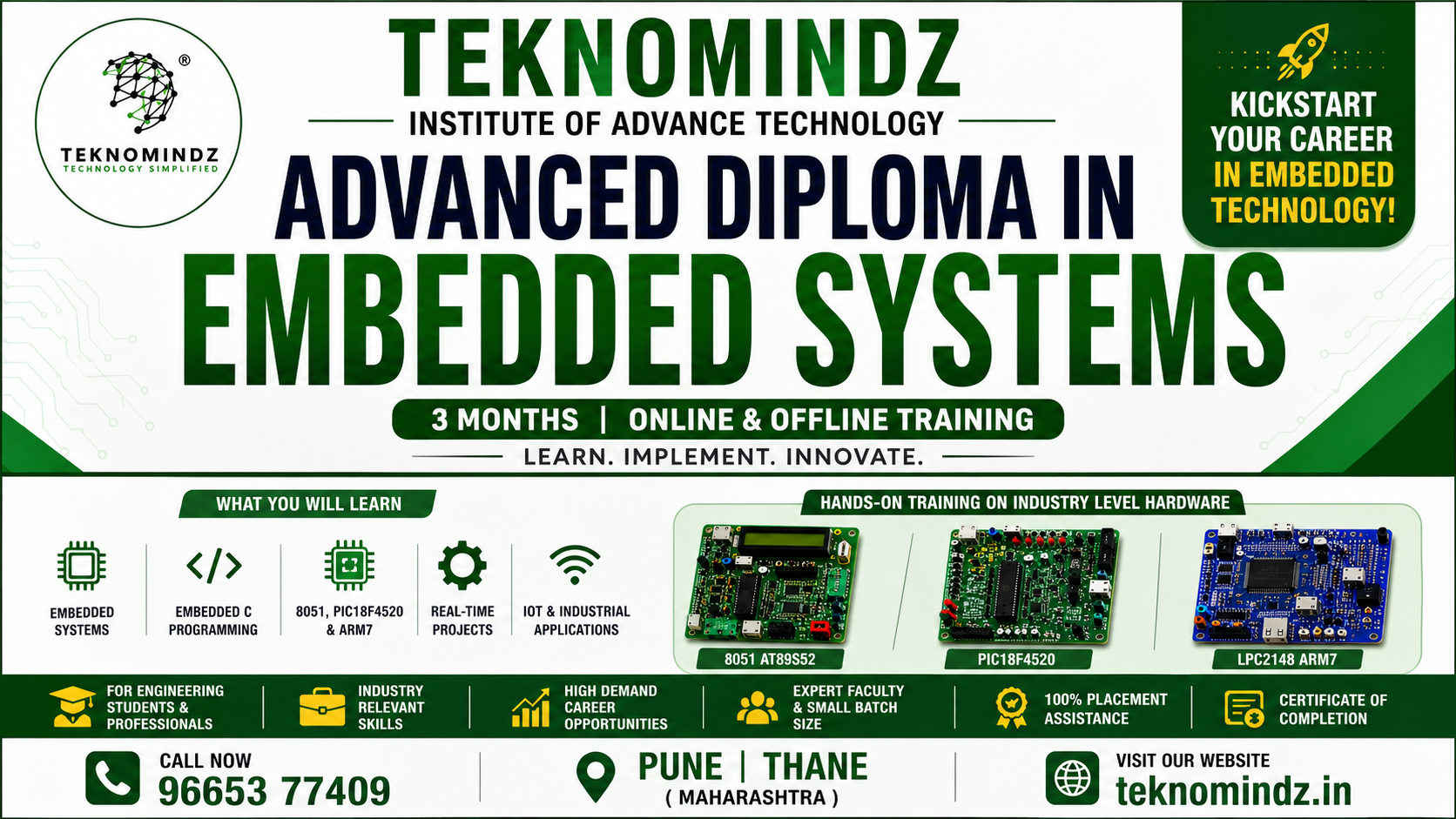
Build Your Career in Embedded Systems with Industry-Oriented Practical Training
The Embedded Systems industry is one of the fastest-growing technology sectors in India and across the world. From smartphones, automobiles, medical devices, industrial automation, robotics, aerospace, defence systems, consumer electronics, and smart home products to IoT-enabled devices, embedded technology is at the heart of modern innovation.
If you are looking for an Advanced Diploma in Embedded Systems Course in Pune, Teknomindz Institute of Advance Technology offers an industry-oriented training program that combines programming fundamentals, microcontroller programming, embedded hardware interfacing, real-time practical sessions, and project-based learning.
Designed for engineering students, diploma holders, graduates, and working professionals, this three-month diploma program equips learners with practical skills in C Programming, 8051 Microcontroller, PIC Microcontroller, ARM7 Microcontroller, Embedded Hardware Interfacing, and Industrial Embedded Programming.
Unlike conventional training programs that focus mainly on theory, our curriculum emphasizes practical implementation using real hardware, development boards, debugging tools, and industry-standard programming techniques.
Whether you aspire to become an Embedded Software Engineer, Firmware Developer, Electronics Design Engineer, or Microcontroller Programmer, this course provides a strong technical foundation to help you launch your career in embedded technology.
An Embedded System is a specialized computer system designed to perform a dedicated function within a larger electronic product. Unlike general-purpose computers, embedded systems are developed to execute specific tasks efficiently, reliably, and often in real time.
Embedded systems combine hardware and software to control electronic devices and are used in millions of products worldwide.
Examples include:
Every electronic device that performs a dedicated task typically contains an embedded system.
The demand for Embedded Systems engineers continues to increase due to rapid advancements in electronics, automation, artificial intelligence, robotics, electric vehicles, and the Internet of Things (IoT).
Companies are actively recruiting engineers with expertise in microcontroller programming, embedded C, firmware development, and hardware interfacing.
Learning Embedded Systems opens career opportunities in industries such as:
With the rise of Industry 4.0 and connected devices, embedded engineers remain among the most sought-after professionals in the electronics sector.
Pune is one of India's leading engineering and technology hubs, home to numerous multinational corporations, research organizations, electronics manufacturers, automotive companies, and embedded product development firms.
The city offers excellent opportunities for students interested in Embedded Systems because of its strong industrial ecosystem and growing demand for skilled electronics engineers.
Many global organizations involved in automotive electronics, industrial automation, semiconductor design, IoT solutions, and embedded software development have major operations in Pune.
Choosing an Embedded Systems Course in Pune allows students to learn close to industry while benefiting from internships, technical events, industrial visits, and placement opportunities.
At Teknomindz Institute of Advance Technology, we believe learning should be practical, industry-oriented, and career-focused.
Instead of simply teaching programming concepts, we train students to build complete embedded applications using actual hardware and development environments.
Our teaching methodology includes:
Our trainers have extensive experience in Embedded Systems, Microcontroller Programming, and Electronics Product Development, ensuring students receive practical knowledge aligned with current industry expectations.
The Advanced Diploma in Embedded Systems has been carefully designed to help students progress from programming fundamentals to advanced microcontroller applications.
Throughout the course, students gain practical knowledge of:
Every module is reinforced through practical experiments using real development boards.
This diploma program is ideal for:
Whether you are preparing for campus placements or looking to upgrade your technical skills, this program provides a structured pathway into the Embedded Systems industry.
Many students wonder about the right time to learn Embedded Systems.
The ideal time is:
Learning Embedded Systems early gives students a competitive advantage during internships, placements, and technical interviews.
Unlike short certification programs that provide only theoretical knowledge, this diploma focuses on developing practical engineering skills.
Students spend significant time working with hardware development boards, writing embedded C programs, debugging applications, reading datasheets, and interfacing electronic components.
By the end of the program, students gain confidence in developing embedded applications independently and are better prepared for industry requirements.
The Advanced Diploma in Embedded Systems at Teknomindz Institute of Advance Technology, Pune is designed to develop students from beginners into industry-ready Embedded Systems engineers. The curriculum begins with the fundamentals of programming and gradually progresses to advanced microcontroller programming, hardware interfacing, communication protocols, and industrial applications.
Every topic is taught through classroom instruction, practical demonstrations, hardware experiments, and programming assignments to ensure students gain both theoretical understanding and hands-on experience.
Programming forms the backbone of every embedded system. Before working with microcontrollers, students must develop a strong understanding of the C programming language, which remains the most widely used language for firmware and embedded software development.
This module begins with the fundamentals of C programming and gradually introduces advanced concepts required for embedded application development.
Students learn how to write efficient, structured, and optimized programs that directly interact with hardware.
Primary Data Types in C
Students begin by understanding how data is stored and processed inside a computer.
Topics include:
Understanding data types helps students write memory-efficient programs suitable for resource-constrained embedded systems.
Operators in C Programming
Operators are the building blocks of programming logic.
Students learn:
Special emphasis is given to Bitwise Operators, as they are extensively used in embedded programming for manipulating hardware registers.
Embedded systems continuously make decisions based on sensor inputs and hardware conditions.
Students learn various decision-making techniques including:
Practical examples demonstrate how electronic devices make intelligent decisions based on real-world inputs.
Automation and repetitive operations are fundamental to embedded software.
Students learn:
Real-world examples include LED blinking, sensor monitoring, keypad scanning, and display control.
Arrays
Arrays allow multiple data values to be stored efficiently.
Topics include:
Applications include sensor data storage, lookup tables, display buffers, and communication packets.
Strings in C
Students learn how text is managed within embedded applications.
Topics include:
String handling becomes particularly useful when working with LCD displays, serial communication, and debugging.
One of the most important programming concepts is modular programming.
Students learn:
Proper use of functions helps create reusable and maintainable embedded software.
Pointers are considered one of the most powerful features of C programming.
Students learn:
Pointers are heavily used in embedded firmware for accessing memory-mapped hardware registers.
Complex embedded applications often require grouping multiple variables.
Students learn:
These concepts are widely used while designing communication packets and hardware configuration structures.
Embedded C is the foundation of firmware development.
Most microcontrollers including:
are programmed primarily using Embedded C.
Mastering this language provides students with the confidence to work on almost every embedded platform.
After building a strong programming foundation, students move to one of the world's most widely studied microcontroller families—the 8051.
Although modern controllers have evolved significantly, learning the 8051 helps students understand core embedded concepts that remain relevant across advanced processors.
Students begin by understanding:
Students receive practical exposure to the AT89S52 development board.
Topics include:
Understanding architecture enables students to visualize how embedded systems function internally.
Topics include:
Students also compare Microprocessor vs Microcontroller, helping them understand why microcontrollers are ideal for embedded applications.
Students are introduced to one of the industry's most popular development environments.
Topics include:
Hands-on practice ensures students become comfortable writing and testing embedded applications.
The first practical experiments introduce GPIO programming.
Students learn:
These simple experiments form the basis of all embedded hardware interfacing.
Students understand how embedded systems communicate with external sensors.
Topics include:
Practical demonstrations illustrate how embedded systems interact with the physical environment.
Students learn matrix keypad programming for user interaction.
Applications include:
Students display information on 16x2 LCD modules.
Topics include:
LCD programming is widely used in industrial products and consumer electronics.
Students understand numerical display systems through practical experiments.
Topics include:
Timing plays a crucial role in embedded programming.
Students learn:
Interrupts enable embedded systems to respond instantly to external events.
Topics include:
Students develop applications that respond immediately to sensor inputs.
Communication between electronic devices is a key aspect of embedded engineering.
Students learn:
These concepts are fundamental for debugging and industrial communication.
By the end of Modules 1 and 2, students have developed a solid understanding of Embedded C programming and 8051 microcontroller programming, providing the foundation required for advanced embedded development.
Excellent. This is Part 3 of your Advanced Diploma in Embedded Systems Course in Pune pillar page. This section covers the advanced microcontroller modules and is written to target SEO keywords like Embedded Systems Course in Pune, PIC Microcontroller Training, ARM7 Programming Course, Firmware Development Course, and Microcontroller Programming Training.
After mastering the fundamentals of Embedded C and 8051 programming, students move to the powerful PIC18F4520 Microcontroller. The PIC family of microcontrollers, developed by Microchip Technology, is widely used in industrial automation, consumer electronics, automotive control systems, instrumentation, and medical devices.
This module focuses on building real-time embedded applications by interfacing sensors, displays, communication peripherals, and analog devices using the PIC18F4520.
Unlike introductory courses, students work directly with actual development boards and hardware components, enabling them to understand how industrial embedded products are designed.
Students begin by understanding the evolution of the PIC microcontroller family and its importance in embedded product development.
Topics include:
Students also learn why many industrial automation companies continue to use PIC controllers for reliable embedded applications.
This section familiarizes students with one of the industry's most popular 8-bit controllers.
Students learn:
Practical sessions ensure students understand every hardware block before programming.
One of the most important concepts in embedded engineering is processor architecture.
Students compare:
Topics covered include:
Students understand why most modern embedded controllers adopt Harvard architecture.
Students study the complete internal architecture including:
This provides a strong understanding of how embedded programs interact with hardware resources.
Students are introduced to Microchip's professional development environment.
Practical sessions include:
Learning MPLAB prepares students for professional embedded software development.
General Purpose Input Output (GPIO) programming forms the foundation of embedded hardware interfacing.
Students perform practical experiments involving:
These exercises help students understand direct hardware interaction.
Professional embedded engineers spend significant time reading datasheets before designing products.
Students learn:
Understanding datasheets enables students to work independently with any microcontroller.
Students develop applications using matrix keypads.
Practical examples include:
Students interface industry-standard 16×2 LCD modules.
Topics include:
LCD programming is widely used in industrial products.
Students learn:
Most real-world sensors produce analog signals.
Students learn:
Students interface sensors such as:
This module demonstrates how embedded systems collect data from the real world.
Communication is one of the most important aspects of embedded systems.
Students learn:
Applications include communication between:
Students gain practical experience implementing Inter-Integrated Circuit (I²C).
Topics include:
I²C remains one of the most widely used communication protocols in embedded systems.
Modern embedded systems increasingly rely on ARM processors due to their high performance, low power consumption, and extensive peripheral support.
This module introduces students to ARM-based embedded development using the LPC2148 microcontroller.
ARM technology powers billions of devices worldwide, including smartphones, industrial controllers, automotive electronics, medical equipment, and IoT products.
Students learn:
Students understand why ARM dominates modern embedded product development.
Students compare two major processor architectures:
This comparison helps students understand why ARM processors are widely adopted in embedded products.
Pipeline execution significantly improves processor performance.
Students learn:
Practical examples illustrate how ARM processors execute multiple instructions simultaneously.
Students are introduced to ARM Cortex architecture concepts including:
This module builds the foundation for advanced ARM programming.
Students study:
Every peripheral is explained with practical demonstrations.
Students perform practical experiments including:
Embedded programming requires direct manipulation of hardware registers.
Students learn:
Bit manipulation is one of the most important skills for firmware engineers.
Students interface LCD displays using ARM controllers.
Applications include:
Students learn how ARM controllers generate analog signals.
Applications include:
Students learn:
RTC is widely used in industrial automation, medical devices, and consumer electronics.
Students understand how processor clocks are generated and optimized.
Topics include:
Students configure UART using PLL and implement serial communication between embedded devices.
Practical exercises include:
PWM is one of the most important concepts in embedded control systems.
Students develop applications involving:
Students implement Serial Peripheral Interface communication.
Topics include:
SPI is widely used in high-speed embedded communication.
Throughout Modules 3 and 4, students spend extensive time working with:
Each experiment reinforces programming concepts with hands-on implementation, helping students develop confidence in real embedded system design.
Perfect. Here's the final part of your Advanced Diploma in Embedded Systems Course in Pune pillar page. This section is designed to improve SEO, GEO, and AEO, while also increasing conversions by answering common user questions and encouraging enquiries.
One of the biggest advantages of joining the Advanced Diploma in Embedded Systems at Teknomindz Institute of Advance Technology, Pune is the opportunity to work on practical hardware projects. Throughout the course, students apply the concepts learned in Embedded C, 8051, PIC18F4520, and ARM7 programming to develop real-world embedded applications.
Projects help students understand how embedded systems are designed, programmed, tested, and deployed in industries.
Some of the projects that students may work on include:
These projects strengthen problem-solving abilities and enhance students' technical portfolios for interviews and placements.
To prepare students for industry requirements, the course includes practical exposure to commonly used Embedded Systems development tools and IDEs.
Students gain experience with:
Practical familiarity with these tools helps students transition smoothly into professional embedded development environments.
The demand for Embedded Systems professionals continues to grow due to rapid advancements in electronics, automotive technology, industrial automation, robotics, IoT, medical devices, consumer electronics, and smart manufacturing.
After successfully completing the course, students can apply for positions such as:
Graduates can find opportunities in industries including:
Salary depends on technical skills, project experience, communication, and interview performance.
Typical salary ranges include:
|
Experience |
Expected Salary |
|
Freshers |
₹3 LPA – ₹6 LPA |
|
1–3 Years |
₹5 LPA – ₹9 LPA |
|
3–5 Years |
₹8 LPA – ₹14 LPA |
|
Senior Embedded Engineers |
₹15 LPA+ |
Professionals with expertise in ARM programming, Embedded C, firmware development, communication protocols, and embedded Linux often command higher salary packages.
Choosing the right training institute plays a crucial role in building a successful engineering career. At Teknomindz Institute of Advance Technology, we focus on practical learning, industry relevance, and career readiness.
Our training approach includes:
We emphasize practical implementation so students gain confidence in designing and programming embedded systems independently.
This course is suitable for:
No prior experience in Embedded Systems is required. Students are guided from programming fundamentals to advanced embedded applications.
Duration: 3 Months
Learning modes include:
This flexible schedule allows both students and working professionals to learn at their convenience.
Upon successful completion of the course, students receive a Course Completion Certificate from Teknomindz Institute of Advance Technology.
The certification reflects practical training in:
An Embedded Systems course teaches students how to design and program electronic systems that perform dedicated tasks using microcontrollers, embedded C programming, and hardware interfacing.
Engineering students, diploma holders, graduates, electronics professionals, and anyone interested in embedded technology can join this course.
Yes. Embedded Systems continues to be one of the fastest-growing technology sectors due to increasing demand in automotive electronics, industrial automation, robotics, IoT, consumer electronics, and medical devices.
Embedded C remains the most widely used programming language for embedded firmware development. Knowledge of C forms the foundation for learning advanced embedded platforms.
ARM processors power billions of devices worldwide, including smartphones, automotive systems, medical equipment, industrial controllers, and IoT devices. Learning ARM programming significantly improves career opportunities.
Students work on practical projects involving LEDs, LCDs, sensors, keypads, serial communication, motor control, PWM applications, ADC systems, and industrial embedded applications.
Yes. Practical laboratory sessions form a core part of the curriculum. Students work with development boards, hardware interfaces, and embedded programming tools throughout the course.
Yes. Teknomindz Institute of Advance Technology offers placement assistance, resume guidance, interview preparation, and mock technical interviews to help students prepare for job opportunities.
Pune is one of India's major engineering and manufacturing hubs, offering excellent opportunities in electronics, automotive, automation, semiconductor, and embedded product development companies.
Students receive practical training in:
These platforms help learners build a strong foundation before progressing to advanced controllers such as STM32 and ESP32.
Whether you are an engineering student preparing for campus placements, a diploma holder looking to specialize, or a working professional planning a career transition, the Advanced Diploma in Embedded Systems provides the practical knowledge and technical confidence required to succeed in the embedded industry.
With a curriculum focused on real-world applications, experienced trainers, hands-on hardware practice, and placement-oriented learning, Teknomindz Institute of Advance Technology has helped students build rewarding careers in Embedded Systems.
If you are searching for an Embedded Systems Course in Pune, Embedded C Training in Pune, Microcontroller Programming Course, or Firmware Development Training, this diploma program offers a structured pathway to becoming an industry-ready Embedded Systems Engineer.
We prepare you for real interviews. Here's a sample of the question types our students face — and how we help them ace them.
Real words from real graduates — every testimonial is from a Teknomindz alumni who completed the program.
Best institute for IoT and Linux training.Trainers explain every concept practically with industry examples and live projects.
Amazing learning experience with advanced Embedded Systems and PCB Designing.Placement assistance was very supportive.
Great infrastructure with individual systems,development boards and practical sessions from the very first day.
Industrial-oriented syllabus and real hardware practice made learning IoT and Embedded Systems very easy and interesting.
Industry-standard development environments, IDEs, and platforms — all covered during the program.