
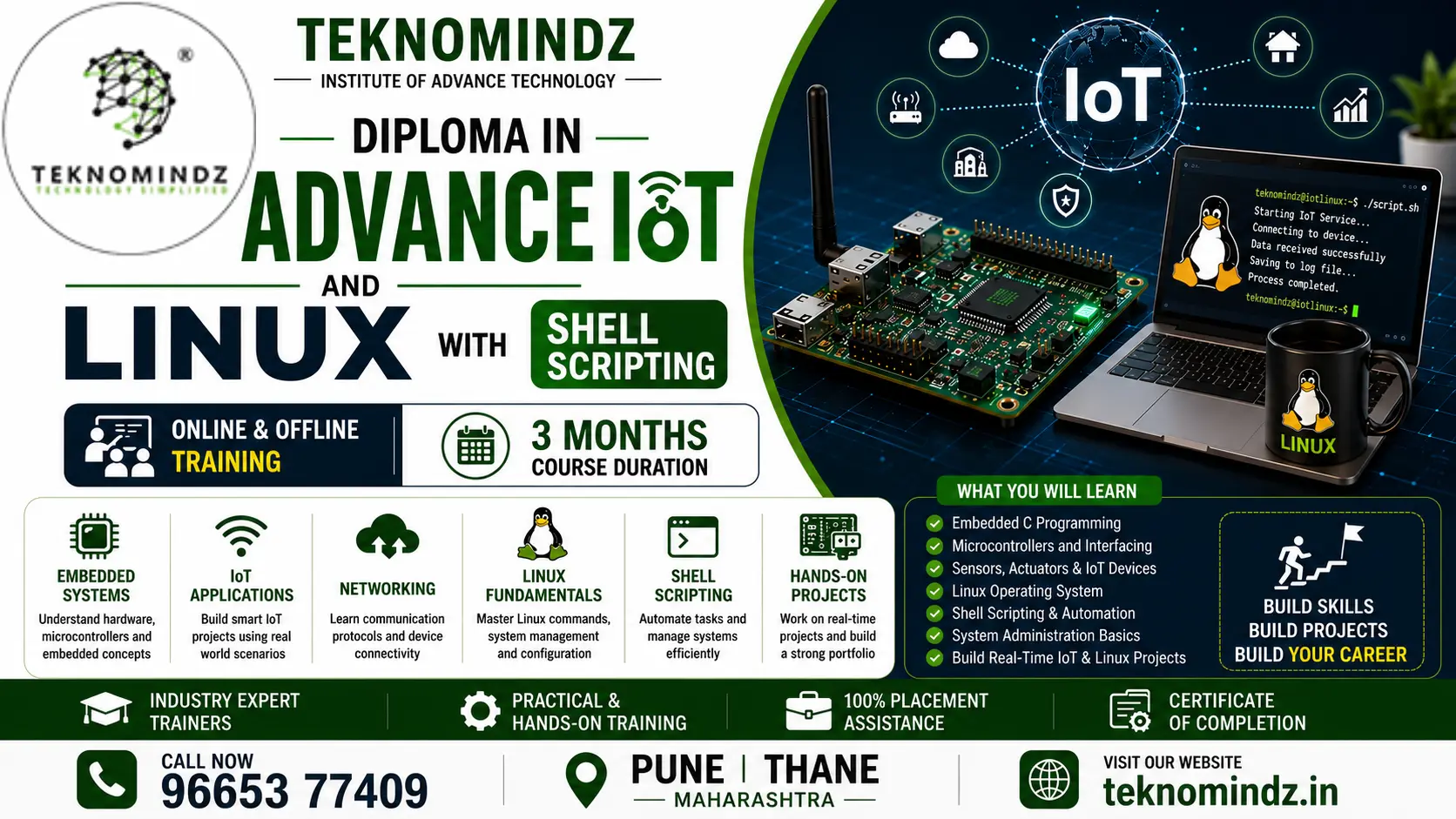
The demand for skilled professionals in the Internet of Things (IoT) and Embedded Linux domain is growing rapidly across industries such as Automotive, Industrial Automation, Healthcare, Smart Homes, Consumer Electronics, Robotics, Agriculture, and Telecommunications. As billions of connected devices continue to transform the world, companies are actively looking for engineers who can design intelligent embedded systems, develop Linux-based applications, and integrate cloud-enabled IoT solutions.
If you are looking to build a successful career in Embedded Systems, Raspberry Pi, Linux Programming, Shell Scripting, or IoT Development, the Diploma in Advance IoT and Linux with Shell Scripting offered by Teknomindz Institute of Advance Technology, Pune is designed specifically for you.
Unlike traditional classroom courses that focus only on theory, this industry-oriented diploma emphasizes practical implementation, hardware interfacing, Linux administration, scripting, networking fundamentals, cloud connectivity, and real-time IoT projects. Every concept is demonstrated through practical sessions using Raspberry Pi, ESP32, Linux operating systems, and IoT platforms to ensure students gain hands-on experience that employers value.
Whether you are an engineering student, diploma holder, graduate, working professional, or someone passionate about Embedded Linux and IoT, this program provides the technical skills needed to work on modern embedded products and smart connected devices.
The Internet of Things is revolutionizing the way electronic devices communicate with each other. From smart homes and wearable devices to industrial automation and autonomous vehicles, IoT technologies are creating new career opportunities across every engineering sector.
Embedded Linux has become the preferred operating system for advanced embedded devices because it offers stability, flexibility, scalability, security, and open-source development capabilities. Today, companies developing networking equipment, medical devices, automotive systems, industrial controllers, surveillance systems, drones, and consumer electronics rely heavily on Embedded Linux.
By combining Linux with IoT technologies, engineers can build intelligent systems capable of sensing, processing, communicating, and controlling devices remotely.
This makes professionals skilled in Linux and IoT among the most sought-after engineers in today's technology industry.
Teknomindz Institute of Advance Technology is recognized for delivering industry-oriented technical training programs designed to bridge the gap between academic learning and industrial requirements.
Our training methodology focuses on practical implementation rather than memorizing concepts. Students work directly with development boards, Linux operating systems, communication protocols, cloud platforms, sensors, and real-world applications throughout the program.
Embedded Linux is a customized version of the Linux operating system specifically designed for embedded devices. Unlike desktop Linux, Embedded Linux is optimized to run efficiently on devices with limited memory, processing power, and storage.
Examples include:
Linux provides stability, multitasking, networking capabilities, security, and complete hardware control, making it the preferred operating system for embedded product development.
The Internet of Things (IoT) refers to the network of physical devices connected through the internet that can collect, exchange, and process data without human intervention.
IoT devices typically include:
These devices continuously communicate with servers, cloud platforms, and mobile applications to automate real-world tasks.
Examples include:
Learning IoT enables engineers to build intelligent systems that interact with the physical world.
Almost every advanced IoT gateway today runs on Linux.
Understanding Linux gives engineers complete control over hardware, networking, processes, memory management, shell scripting, and device communication.
Linux knowledge is essential for:
Professionals who understand Linux can troubleshoot embedded devices more effectively and develop reliable embedded applications.
The Diploma in Advance IoT and Linux with Shell Scripting is carefully designed to provide a balance of Linux fundamentals, Shell Programming, Raspberry Pi development, cloud-based IoT platforms, communication protocols, and real-world implementation.
Unlike many short-term certification programs, this diploma focuses on building practical engineering skills that prepare students for real industry projects.
This diploma is suitable for:
No prior experience in Linux is required. The course starts from the fundamentals and gradually progresses to advanced IoT implementation using industry-standard tools and hardware.
The Diploma in Advance IoT and Linux with Shell Scripting at Teknomindz Institute of Advance Technology is designed to take students from Linux fundamentals to advanced IoT application development using Raspberry Pi, ESP32, cloud platforms, and modern communication protocols.
Unlike conventional classroom training, every module combines theoretical concepts with extensive laboratory sessions, ensuring that students gain practical experience while developing industry-ready applications.
The journey begins with understanding the Linux operating system on Raspberry Pi. Students first learn how Linux differs from Windows, why it dominates the embedded world, and why companies prefer Linux for industrial products.
Topics covered include:
Students also learn how Linux interacts with processors, memory, storage devices, USB peripherals, and GPIO hardware.
By the end of this module, students can confidently install and configure Raspberry Pi systems from scratch.
Understanding the Linux file system is essential for every Embedded Linux engineer.
Students learn:
This module explains how Linux organizes data internally and how embedded devices communicate with storage hardware.
Students gain practical experience working with storage devices, partitions, USB drives, SD cards, and filesystem management.
Modern Embedded Linux development requires strong command-line skills.
Students learn to perform daily administrative tasks using the Linux terminal.
Practical topics include:
Students become comfortable working completely inside the Linux terminal without depending on graphical interfaces.
One of the most powerful features of Linux is the Shell.
Students learn how the shell interprets commands, manages processes, and automates repetitive tasks.
Topics include:
Practical exercises ensure students understand real Linux workflow used by embedded engineers worldwide.
Automation is one of the most important skills in Linux.
This module teaches students how to write professional Shell Scripts for automating system tasks.
Students learn:
Practical scripting exercises include:
These scripting skills are extensively used by Linux administrators, DevOps engineers, and Embedded Linux developers.
Automation plays a major role in embedded product development.
Students learn how embedded devices automatically execute scripts during startup.
Topics include:
Students create automation scripts that start applications automatically whenever Raspberry Pi powers on.
Raspberry Pi acts as the central processing unit for many IoT systems.
Students learn:
Practical sessions help students interface real hardware devices using Raspberry Pi.
Image processing and surveillance applications are becoming increasingly popular.
Students learn:
Applications include:
Embedded devices increasingly use graphical interfaces.
Students learn:
Students build interactive applications that communicate with sensors and hardware devices.
This module introduces students to connected embedded systems.
Topics include:
Students understand how embedded devices communicate with cloud platforms.
Students gain hands-on experience with industry-leading IoT platforms.
Topics include:
Students upload sensor data from Raspberry Pi to cloud dashboards and visualize live information.
Telegram has become one of the easiest methods for controlling IoT devices remotely.
Students learn:
Students build systems capable of sending automatic alerts directly to Telegram.
MQTT is the most widely used communication protocol in IoT.
Students learn:
Practical projects demonstrate communication between Raspberry Pi, ESP32, and cloud servers.
Students learn advanced message queuing using RabbitMQ.
Topics include:
RabbitMQ is widely used in enterprise IoT systems requiring reliable communication.
This curriculum not only teaches the technology but also builds the practical confidence required to work on real-world Embedded Linux and IoT applications.
Modern IoT devices communicate using lightweight messaging protocols designed for fast, reliable, and secure data transmission. Understanding these protocols is essential for engineers developing connected products.
In this module, students gain practical experience implementing industry-standard communication technologies that are widely used in smart homes, industrial automation, healthcare devices, agriculture, logistics, and intelligent transportation systems.
Node-RED is one of the most popular visual programming tools used for developing Internet of Things applications without writing extensive code.
Students learn how to design complete IoT workflows using drag-and-drop programming techniques.
Topics covered include:
By the end of this module, students can build complete IoT dashboards for monitoring and controlling embedded devices remotely.
The Constrained Application Protocol (CoAP) is designed for low-power IoT devices operating over constrained networks.
Students gain practical knowledge of:
This protocol is widely used in industrial IoT systems where bandwidth and power consumption must be minimized.
ESP32 has become one of the most widely used Wi-Fi and Bluetooth-enabled microcontrollers in the IoT industry.
Students begin by understanding the architecture and capabilities of the ESP32 development board.
Topics include:
Students develop multiple practical applications using ESP32 and Raspberry Pi working together.
Understanding how hardware communicates with the operating system is an important aspect of Embedded Linux development.
Students learn:
This module helps students understand how Linux recognizes and manages connected hardware devices.
Blynk is a cloud-based IoT platform used for developing mobile-controlled embedded systems.
Students learn to create mobile applications capable of remotely monitoring and controlling electronic devices.
Topics include:
Students create real-world applications that can be controlled from Android and iOS smartphones.
This practical module combines hardware control with cloud connectivity.
Students build applications capable of controlling servo motors remotely using mobile devices.
Practical exercises include:
This module demonstrates how IoT platforms can control physical hardware over the internet.
Voice-controlled embedded systems are becoming increasingly common in smart homes and industrial automation.
Students learn how to integrate IoT devices with:
Topics covered include:
Students build voice-controlled projects where lights, motors, and appliances can be operated using spoken commands.
Bluetooth remains one of the most widely used wireless technologies in embedded product development.
Students gain practical experience in:
Applications include home automation, wearable devices, industrial monitoring, and wireless sensor networks.
At Teknomindz Institute of Advance Technology, practical implementation forms the core of the learning process.
Every topic is accompanied by extensive laboratory exercises using actual hardware.
Students perform experiments involving:
These practical sessions help students understand the complete workflow of Embedded Linux and IoT application development.
Throughout the diploma program, students work on multiple hands-on projects that simulate real industrial scenarios.
Sample project ideas include:
These projects strengthen practical skills and help students build an impressive portfolio for placements and interviews.
During the course, students gain experience with widely used software tools and platforms, including:
Learning these technologies prepares students to work in professional Embedded Linux and IoT development environments.
The knowledge gained in this diploma can be applied across numerous industries, including:
As organizations continue to adopt connected technologies, the demand for engineers skilled in Embedded Linux, IoT platforms, Raspberry Pi, ESP32, and Linux Shell Scripting continues to grow, making this diploma a valuable investment for aspiring embedded professionals.
The demand for professionals skilled in Embedded Linux, Internet of Things (IoT), Raspberry Pi, ESP32, and Linux Shell Scripting continues to grow as industries embrace automation and connected technologies. From startups to multinational corporations, organizations are investing in smart products that require engineers with practical knowledge of embedded software and Linux-based systems.
After successfully completing this diploma, students can pursue exciting career opportunities across various industries.
The skills learned in this course are applicable in sectors such as Automotive Electronics, Consumer Electronics, Healthcare, Smart Manufacturing, Industrial Automation, Agriculture Technology, Aerospace, Robotics, Telecommunications, Energy Management, and Smart City projects.
The salary offered depends on your skills, project experience, technical knowledge, and interview performance. Engineers with strong practical knowledge of Embedded Linux and IoT technologies are highly valued by employers.
Typical salary ranges in India include:
| Experience | Expected Salary |
|---|---|
| Freshers | ₹3 LPA – ₹6 LPA |
| 1–3 Years | ₹5 LPA – ₹9 LPA |
| 3–5 Years | ₹8 LPA – ₹15 LPA |
| Senior Embedded Linux Engineers | ₹15 LPA and above |
Professionals who continue learning advanced Linux kernel development, device drivers, cloud computing, and embedded networking can further enhance their career prospects.
This diploma is suitable for anyone interested in building a career in Embedded Systems, Linux, and IoT.
No prior Linux programming experience is required. The curriculum begins with the fundamentals and gradually progresses to advanced Embedded Linux and IoT application development.
Diploma in Advance IoT and Linux with Shell Scripting
Duration: 3 Months
Flexible learning options are available to suit different schedules.
Students receive extensive practical exposure irrespective of the learning mode they choose.
At Teknomindz Institute of Advance Technology, we believe practical implementation is the key to mastering Embedded Linux and IoT.
Our teaching methodology includes:
This approach helps students gain confidence before entering the industry.
Upon successful completion of the course, students receive a Course Completion Certificate from Teknomindz Institute of Advance Technology.
The certification demonstrates proficiency in:
Teknomindz supports students throughout their career journey by providing placement assistance and interview preparation.
Our placement support includes:
The objective is to prepare students for technical interviews with confidence and practical knowledge.
Students choose Teknomindz because of our practical approach and industry-oriented learning methodology.
Our mission is to help students become confident Embedded Systems and IoT professionals capable of working on real-world engineering challenges.
The course duration is 3 months and includes practical laboratory sessions along with project work.
No. The course starts from Linux fundamentals and gradually moves toward advanced Embedded Linux concepts.
Yes. Students gain practical experience using Raspberry Pi for Linux programming and IoT applications.
Yes. ESP32 programming, Wi-Fi connectivity, and Bluetooth applications are covered as part of the curriculum.
Yes. Linux Shell Scripting is one of the core modules and includes variables, loops, conditions, functions, automation scripts, and command-line programming.
Yes. Students learn MQTT, RabbitMQ, CoAP, Node-RED, ThingSpeak, Telegram integration, and Blynk IoT.
Yes. Beginners, engineering students, diploma holders, and working professionals can join.
Yes. Online, Offline, Weekend, and Fast Track batches are available.
Yes. Students work on multiple real-time IoT and Embedded Linux projects using Raspberry Pi and ESP32.
Yes. Teknomindz provides placement assistance, resume preparation, interview guidance, and mock technical interviews.
The future belongs to intelligent connected devices, embedded software, and Linux-powered systems. Whether you aspire to become an Embedded Linux Engineer, IoT Developer, Firmware Engineer, or Automation Specialist, the Diploma in Advance IoT and Linux with Shell Scripting at Teknomindz Institute of Advance Technology provides the practical knowledge and technical foundation needed to succeed.
Join a learning environment where theory is reinforced with hands-on practice, real hardware, and industry-focused projects. With experienced trainers, flexible learning options, and placement assistance, Teknomindz helps you gain the confidence and skills required to excel in the rapidly evolving world of Embedded Systems and IoT.
Start your journey today.
📍 Teknomindz Institute of Advance Technology – Pune
📞 +91 96653 77409
Real words from real graduates — every testimonial is from a Teknomindz alumni who completed the program.
Best institute for IoT and Linux training.Trainers explain every concept practically with industry examples and live projects.
Amazing learning experience with advanced Embedded Systems and PCB Designing.Placement assistance was very supportive.
Great infrastructure with individual systems,development boards and practical sessions from the very first day.
Industrial-oriented syllabus and real hardware practice made learning IoT and Embedded Systems very easy and interesting.