What Is the Best Embedded Systems Course in Pune? A Complete Guide for Engineering Students
If you are an engineering or diploma student looking to build a career in electronics, firmware, IoT, automotive electronics or hardware-software development, Embedded Systems can be an excellent career direction.
But with many institutes offering embedded training in Pune, one important question comes up:
What is the best Embedded Systems Course in Pune?
The answer should not be based only on course fees, certificates or advertisements. A good embedded systems program should help you understand how hardware and software work together, develop programming skills, work with microcontrollers, troubleshoot real hardware and build practical projects.
This guide explains what students should look for when choosing an Embedded Systems Course in Pune.
What Is an Embedded System?
An embedded system is a combination of hardware and software designed to perform a specific function.
You interact with embedded systems every day through products such as:
-
Automobiles
-
Washing machines
-
Smart TVs
-
Medical equipment
-
Industrial machines
-
Consumer electronics
-
IoT devices
-
Security systems
-
Robotics
-
Communication equipment
Unlike conventional software applications, embedded systems often need to interact directly with hardware components such as sensors, motors, displays, communication modules and electronic circuits.
That is why embedded development requires knowledge of both programming and electronics.
What Should the Best Embedded Systems Course in Pune Teach?
Before joining any institute, carefully examine the syllabus.
A comprehensive Embedded Systems Course in Pune should ideally provide exposure to several important areas.
1. Embedded C Programming
C is one of the most important programming languages used in embedded development.
Students should learn concepts such as:
-
Variables and data types
-
Pointers
-
Arrays
-
Structures
-
Functions
-
Memory concepts
-
Bit manipulation
-
Preprocessors
-
Interrupt-related programming
-
Embedded programming techniques
The objective should not be simply learning C syntax. Students should understand how C is used to control and interact with hardware.
2. Microcontrollers
Microcontrollers are at the heart of many embedded systems.
A practical course should introduce students to:
-
Microcontroller architecture
-
GPIO
-
Timers
-
Counters
-
Interrupts
-
ADC
-
PWM
-
Memory
-
Peripheral interfaces
Students should get opportunities to write programs and test them on actual hardware wherever possible.
3. ARM and Modern Microcontrollers
Modern embedded development frequently involves ARM-based microcontrollers.
A good training program can introduce students to ARM architecture and practical development using suitable development boards and microcontrollers.
This helps learners move beyond basic programming exercises and understand how modern embedded products are developed.
4. Communication Protocols
Embedded devices rarely work in isolation.
They need to communicate with sensors, displays, controllers and other electronic devices.
Therefore, students should understand protocols such as:
UART | SPI | I2C | CAN
Understanding these protocols is particularly useful for students interested in automotive, industrial electronics and IoT applications.
5. Real-Time Operating Systems
After learning bare-metal embedded programming, students can move towards RTOS concepts.
A good embedded training program may introduce:
-
Tasks
-
Scheduling
-
Priorities
-
Semaphores
-
Mutex
-
Queues
-
Inter-task communication
-
Timing
-
Real-time concepts
RTOS knowledge can be particularly useful for students who want to move towards advanced embedded software development.
Why Practical Training Matters
One of the biggest differences between simply studying embedded systems and actually learning embedded development is practical implementation.
You can read about GPIO, UART or interrupts in a textbook, but embedded development becomes much clearer when you actually:
Write code → Program the controller → Connect hardware → Test → Debug → Fix the problem
That is why students comparing an Embedded Systems Training Institute in Pune should ask about laboratory facilities and practical sessions.
A useful course should ideally provide exposure to:
-
Development boards
-
Microcontrollers
-
Sensors
-
Displays
-
Communication modules
-
Electronic components
-
Debugging
-
Hardware interfacing
-
Firmware testing
Projects Should Be an Important Part of the Course
Projects help students connect different concepts.
For example, a project may combine:
Microcontroller + Embedded C + Sensor + Communication Protocol + Display + Firmware
This is much closer to how embedded systems are developed in real applications.
When evaluating an Embedded Systems Course in Pune, ask:
How many practical projects will I work on?
Also ask whether the project is actually implemented or simply submitted as documentation.
Who Can Join an Embedded Systems Course?
Embedded systems training can be considered by learners from several technical backgrounds, including:
-
BE Electronics Engineering
-
BE Electronics & Telecommunication
-
Diploma Electronics
-
Electrical Engineering
-
Instrumentation
-
Computer Engineering students interested in hardware
-
Recent engineering graduates
-
Students looking to transition into embedded development
The exact eligibility requirements can vary between courses, so students should check the institute's current admission criteria before enrolling.
What Career Opportunities Are Available?
Embedded systems is a broad field. Depending on your skills and specialization, you can explore career paths such as:
Embedded Software Engineer
Develops firmware and software that interacts with embedded hardware.
Embedded Firmware Engineer
Works on low-level firmware, microcontrollers, peripherals and hardware interfaces.
Embedded Developer
Works across programming, hardware interaction, debugging and system integration.
IoT Engineer
Develops connected devices combining embedded systems, sensors, communication and cloud technologies.
Automotive Embedded Engineer
Works on embedded systems used in vehicles and automotive electronics.
RTOS Developer
Works with real-time operating systems and task-based embedded applications.
Embedded Linux Engineer
Works with Linux-based embedded platforms, applications and system-level development.
Device Driver Developer
Develops software that enables operating systems or applications to communicate with hardware.
Embedded Test Engineer
Tests embedded software and hardware systems, identifies problems and validates system behaviour.
Hardware-Firmware Engineer
Works at the intersection of electronic hardware and embedded software.
Why Pune Is an Important Location for Embedded Systems Training
Pune is a major engineering and technology hub with strong activity across automotive, manufacturing, electronics, software and industrial technology.
For students looking for Embedded Systems Classes in Pune, this makes the city an attractive location for developing skills relevant to multiple technology sectors.
However, location alone should not determine your choice of institute.
The quality of training, practical exposure, projects, faculty and curriculum are more important factors.
How to Choose the Best Embedded Systems Training Institute in Pune
Before paying the course fee, ask these questions:
✅ Is the syllabus updated?
Check whether it covers modern embedded programming rather than only basic electronics.
✅ Is there real hardware?
Ask whether students actually work with development boards and electronic components.
✅ Is Embedded C taught practically?
Programming should involve actual hardware implementation.
✅ Are communication protocols covered?
UART, SPI, I2C and CAN are valuable areas to understand.
✅ Is RTOS included?
If you want advanced embedded software skills, RTOS can be an important component.
✅ Are projects included?
Ask about the type and number of practical projects.
✅ Who teaches the course?
Understand the trainer's technical and industry experience.
✅ Is debugging covered?
Debugging is an essential embedded engineering skill and should not be ignored.
✅ What happens after classroom training?
Ask whether the program includes projects, internship opportunities, career guidance or other practical exposure—and understand exactly what is included rather than relying on broad promotional claims.
Embedded Systems Course at Teknomindz, Pune
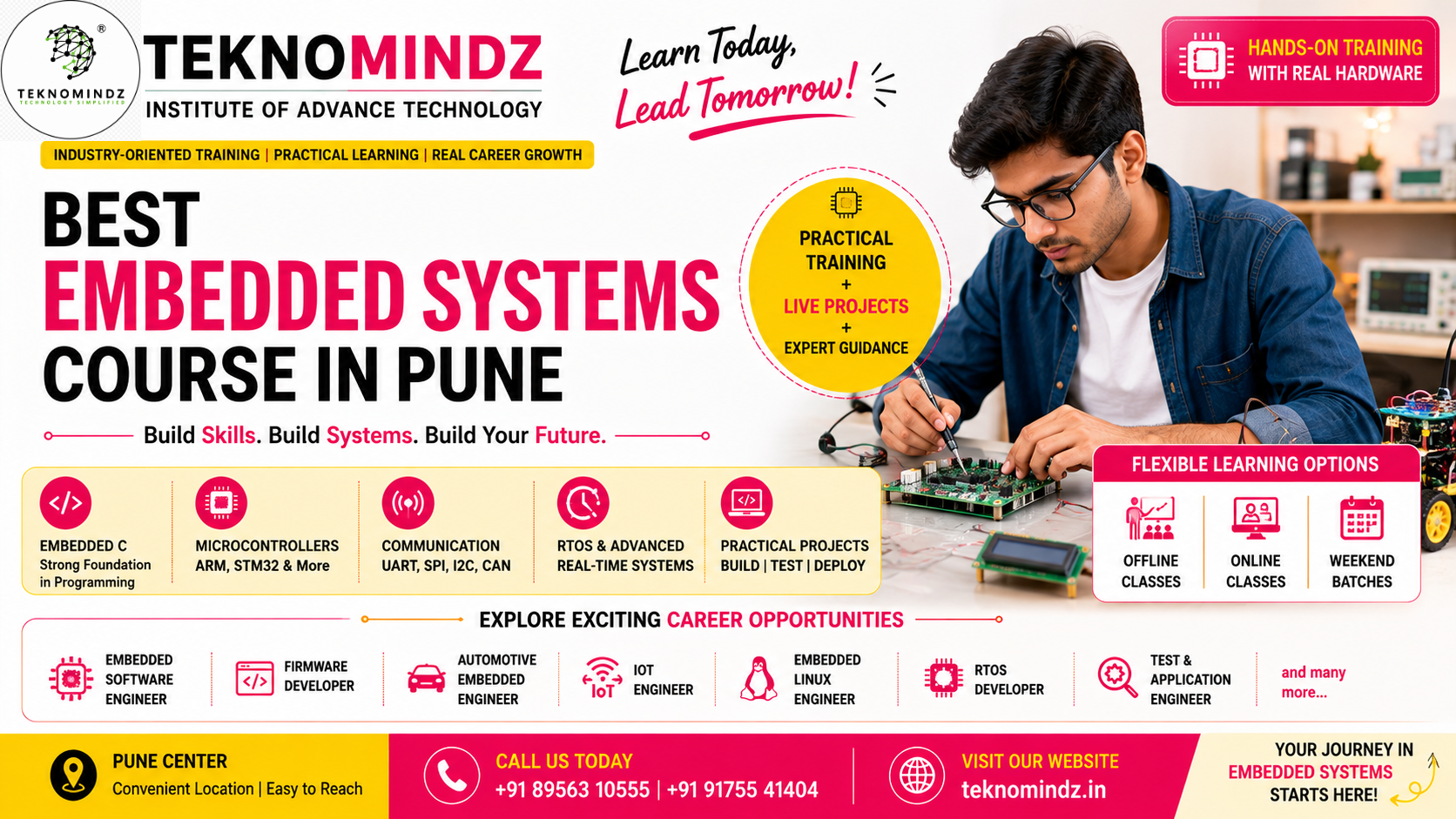
At Teknomindz Institute of Advance Technology, the Embedded Systems training approach is focused on industry-oriented learning, practical training and real hardware experience.
The program is designed around areas such as embedded programming, hardware interaction, microcontrollers, practical projects and advanced embedded technologies.
The training environment includes:
-
Hands-on practical training
-
Real hardware experience
-
Live projects and case studies
-
Industry-oriented learning
-
Expert faculty
-
Online, offline and weekend batches
For students who want to learn embedded systems rather than simply complete a theoretical course, practical exposure can make an important difference.
Is an Embedded Systems Course Worth It for Engineering Students?
It can be a strong option for students who enjoy both programming and electronics.
If you like understanding how a piece of code can control a motor, read a sensor, communicate with another device or operate an electronic product, embedded systems can be an interesting career path.
However, students should understand that completing a course alone does not automatically guarantee a career.
Your growth will depend on:
Programming skills + Electronics knowledge + Practical Projects + Debugging + Problem Solving + Continuous Learning
The more effectively you can demonstrate these skills, the better prepared you can be for embedded engineering opportunities.
Frequently Asked Questions
What is the best Embedded Systems Course in Pune?
The best course depends on your objectives, but students should look for a program covering Embedded C, microcontrollers, ARM, communication protocols, RTOS, hardware interfacing, debugging and practical projects.
Is Embedded Systems good for E&TC students?
Yes. E&TC students already have exposure to electronics and communication concepts, which can provide a useful foundation for embedded systems.
Is Embedded C important for embedded jobs?
Yes. Embedded C is an important foundational skill for many microcontroller and firmware development roles.
Should I learn microcontrollers before RTOS?
For beginners, it is generally easier to understand microcontrollers, interrupts and embedded programming fundamentals before moving into RTOS concepts.
Is practical training important in embedded systems?
Yes. Embedded development involves hardware-software interaction, so practical implementation and debugging are extremely valuable.
What career options are available after embedded systems training?
Possible career paths include Embedded Software Engineer, Firmware Engineer, Embedded Developer, IoT Engineer, Automotive Embedded Engineer, RTOS Developer, Embedded Linux Engineer, Device Driver Developer and Embedded Test Engineer.
Where can I learn Embedded Systems in Pune?
Students looking for Embedded Systems Training in Pune can compare institutes based on syllabus, practical hardware exposure, projects, faculty, course structure and learning options.
Final Checklist Before Joining an Embedded Systems Course
Before choosing an institute, ask yourself:
Does the course teach programming?
Will I work on real hardware?
Will I build projects?
Will I learn microcontrollers?
Are communication protocols included?
Is RTOS covered?
Will I learn debugging?
Are experienced trainers involved?
Does the course match my career goal?
If the answer to these questions is yes, you are much closer to finding a suitable Embedded Systems Course in Pune.