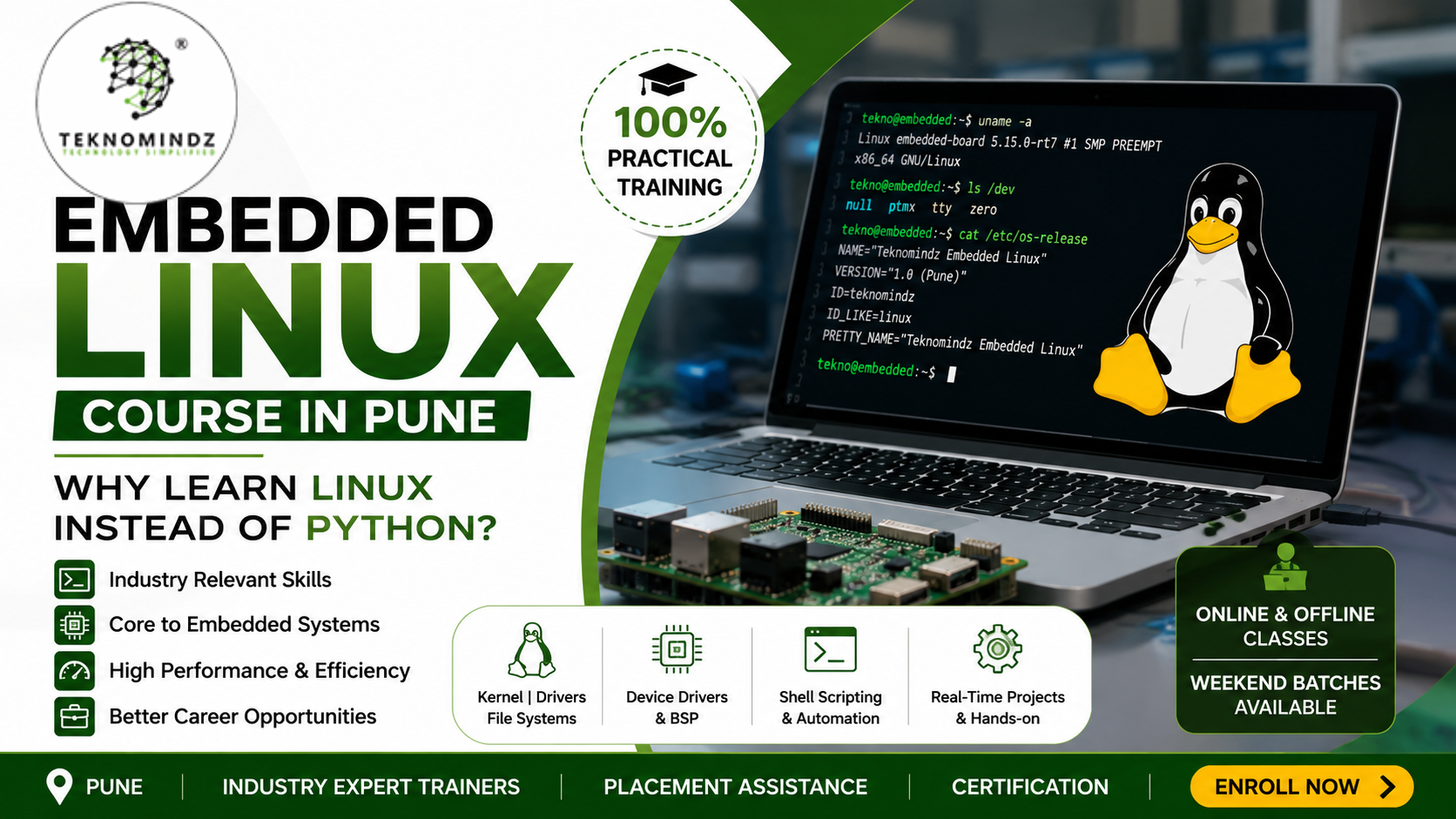
Why Learn Embedded Linux Instead of Only Python?
Many engineering students and fresh graduates often ask an important question:
"Should I learn Python or Embedded Linux?"
The answer depends on your career goals. Python is undoubtedly one of the world's most popular programming languages and is widely used in web development, automation, artificial intelligence, data science, and scripting. However, if your goal is to build a career in Embedded Systems, IoT, Robotics, Automotive Electronics, Industrial Automation, Medical Devices, Consumer Electronics, or Firmware Development, learning Embedded Linux provides a much stronger technical foundation.
In reality, the best embedded engineers use both Linux and Python. However, learning Embedded Linux first helps you understand how embedded hardware and software work together, making you a more versatile engineer.
What is Python?
Python is a high-level programming language known for its simple syntax and ease of learning. It is widely used in software development, web applications, machine learning, artificial intelligence, automation, and data analysis.
Python is an excellent choice for beginners because it allows developers to write programs quickly with fewer lines of code.
Python is commonly used in:
-
Web Development
-
Artificial Intelligence
-
Data Science
-
Machine Learning
-
Automation
-
Scripting
-
Cyber Security
-
Cloud Computing
However, Python generally operates on top of an operating system and does not directly control hardware components.
What is Embedded Linux?
Embedded Linux is a customized Linux operating system designed specifically for embedded devices and intelligent electronic products.
Unlike desktop Linux, Embedded Linux is optimized for hardware control, networking, multitasking, and real-time communication.
Embedded Linux is used in:
-
Smart TVs
-
Automotive Systems
-
Industrial Controllers
-
IoT Gateways
-
Medical Equipment
-
Networking Devices
-
Routers
-
Smart Cameras
-
Drones
-
Robotics
-
Consumer Electronics
-
Smart Home Devices
Engineers working with Embedded Linux interact directly with hardware, processors, communication protocols, memory, peripherals, and embedded applications.
Python vs Embedded Linux
| Feature | Python | Embedded Linux |
|---|---|---|
| Programming Language | Yes | Operating System Platform |
| Hardware Programming | Limited | Extensive |
| GPIO Access | Through libraries | Native support |
| Used in Embedded Products | Sometimes | Widely |
| IoT Development | Yes | Essential |
| Device Drivers | No | Yes |
| Linux Commands | Not required | Essential |
| Shell Scripting | No | Yes |
| Process Management | Limited | Complete |
| System Administration | No | Yes |
| Networking Configuration | Limited | Complete |
| Industrial Usage | Medium | Very High |
| Real-Time Products | Limited | Commonly Used |
Why Embedded Linux Gives You More Career Opportunities
Modern electronic products are becoming smarter every day. Most advanced devices run on Linux because it offers stability, flexibility, networking capabilities, and hardware control.
When you learn Embedded Linux, you understand how complete embedded products are built—from booting the operating system to controlling hardware and communicating with cloud platforms.
This broader understanding opens doors to a wider range of engineering roles compared to learning only a programming language.
Professionals with Embedded Linux skills are commonly hired by companies developing:
-
Automotive Electronics
-
Medical Devices
-
Consumer Electronics
-
Industrial Automation Systems
-
Networking Equipment
-
IoT Products
-
Aerospace Systems
-
Robotics
-
Smart Home Devices
-
Surveillance Systems
Embedded Linux Engineers Understand the Entire System
A Python developer usually focuses on writing software applications.
An Embedded Linux Engineer understands the complete embedded ecosystem, including:
-
Operating Systems
-
Hardware Architecture
-
Raspberry Pi
-
Embedded Processors
-
Linux Commands
-
Shell Scripting
-
File Systems
-
Device Drivers
-
Networking
-
GPIO Programming
-
Communication Protocols
-
IoT Platforms
-
Cloud Connectivity
This complete system knowledge makes embedded engineers valuable across multiple industries.
Linux is the Foundation of Modern Technology
Many technologies that people use daily run on Linux.
Examples include:
-
Android Smartphones
-
Smart TVs
-
Wi-Fi Routers
-
Raspberry Pi
-
Industrial Controllers
-
Cloud Servers
-
Supercomputers
-
Automotive Infotainment Systems
-
IoT Gateways
-
Security Appliances
Learning Linux helps you understand how these devices function internally.
Why Shell Scripting Matters
Shell Scripting is one of the most powerful features of Linux.
Instead of performing repetitive tasks manually, engineers automate them using Shell Scripts.
Shell scripting is used for:
-
System Automation
-
Software Installation
-
Backup Management
-
Device Configuration
-
Log Monitoring
-
File Processing
-
Testing
-
Embedded Product Deployment
Python is excellent for application development, but Shell Scripting is indispensable for Linux administration and embedded product maintenance.
Embedded Linux is Essential for IoT Development
Most advanced IoT gateways operate on Linux.
Whether you are working with Raspberry Pi, ESP32, industrial controllers, or cloud-connected embedded systems, Linux serves as the operating platform.
Embedded Linux engineers learn to work with:
-
MQTT
-
Node-RED
-
RabbitMQ
-
ThingSpeak
-
CoAP
-
Raspberry Pi
-
ESP32
-
Bluetooth
-
Wi-Fi
-
Cloud Platforms
These technologies are fundamental to building reliable IoT solutions.
Python and Embedded Linux Work Together
One common misconception is that students must choose either Python or Embedded Linux.
In reality, they complement each other.
For example:
-
Python can be used to create applications, automate tasks, and process data.
-
Embedded Linux provides the operating system, hardware access, networking, and platform on which those Python applications run.
An engineer proficient in both technologies has a significant advantage in the job market.
Which Should You Learn First?
If your goal is to become a:
-
Embedded Systems Engineer
-
Firmware Developer
-
IoT Engineer
-
Linux Engineer
-
Robotics Engineer
-
Automotive Software Engineer
-
Industrial Automation Engineer
then learning Embedded Linux first is highly recommended.
Once you are comfortable with Linux, Shell Scripting, Raspberry Pi, and IoT fundamentals, learning Python becomes much easier and more meaningful because you'll understand where and how Python fits into embedded applications.
Learn Embedded Linux at Teknomindz Institute of Advance Technology
At Teknomindz Institute of Advance Technology, students don't just learn Linux commands—they build practical skills through hands-on training with Raspberry Pi, ESP32, Shell Scripting, IoT communication protocols, and real-world projects.
Our Diploma in Advance IoT and Linux with Shell Scripting is designed to help engineering students and professionals develop industry-ready expertise in Embedded Linux and connected systems.
With experienced trainers, practical lab sessions, real hardware exposure, and placement assistance, Teknomindz prepares students for rewarding careers in Embedded Systems and IoT.
Conclusion
Python is an excellent programming language and remains an important skill for modern developers. However, if your ambition is to design intelligent electronic products, work with hardware, build connected devices, or pursue a career in Embedded Systems and IoT, Embedded Linux offers a broader and more specialized foundation.
Rather than viewing Python and Embedded Linux as competing technologies, consider them complementary. By mastering Embedded Linux first and then adding Python to your skill set, you position yourself for a wider range of opportunities in today's technology-driven industries.
Start your Embedded Linux journey with Teknomindz Institute of Advance Technology and gain the practical skills needed to succeed in the world of Embedded Systems and IoT.