
Demystifying 32-Bit Architecture: Why We Teach STM32 and ESP32 over Legacy 8051
Walk into any industrial R&D facility, smart appliance startup, or automotive design house in Pune today, and look at the hardware engineering benches. You will see engineers actively building applications for smart grids, wearable medical devices, and connected vehicle tracking systems. However, you will rarely see anyone designing commercial hardware around legacy 8-bit microcontrollers like the 8051 or traditional AVR chips.
Yet, many training institutes continue to spend months teaching outdated 8-bit platforms. At Teknomindz Systems and Services LLP, we believe your training should align perfectly with what global tech companies actually look for on your resume. Our Embedded Systems Course in Pune focuses heavily on modern, industrial-grade 32-bit hardware architectures: the STM32 and the ESP32.
The Structural Shift: 8-Bit vs. Modern 32-Bit Systems
An 8-bit microcontroller processes data in smaller chunks. While it works well for teaching basic register concepts or building simple blinking LED sequences, it lacks the memory, processing power, and peripheral capabilities required for modern applications like Edge AI, real-time cryptography, or wireless mesh networking.
| Feature | Legacy 8051 / 8-Bit | Modern STM32 / ESP32 (32-Bit) |
|---|---|---|
| Data Width | 8 bits (Processes data slowly in small chunks) | 32 bits (Processes complex mathematics instantly) |
| Clock Speed | Typically 11 MHz to 24 MHz | Up to 160 MHz - 240 MHz |
| On-Chip Wireless | None (Requires external hardware chips) | Integrated Wi-Fi, BLE, and Bluetooth (ESP32) |
| Operating System Support | Extremely limited (No memory for real RTOS) | Designed for FreeRTOS and Embedded Linux |
| Industry Demand | Largely legacy systems / Hobbyist projects | Dominates Automotive, Medical, and Smart IoT |
Why STM32 Training in Pune is Crucial for Your Resume
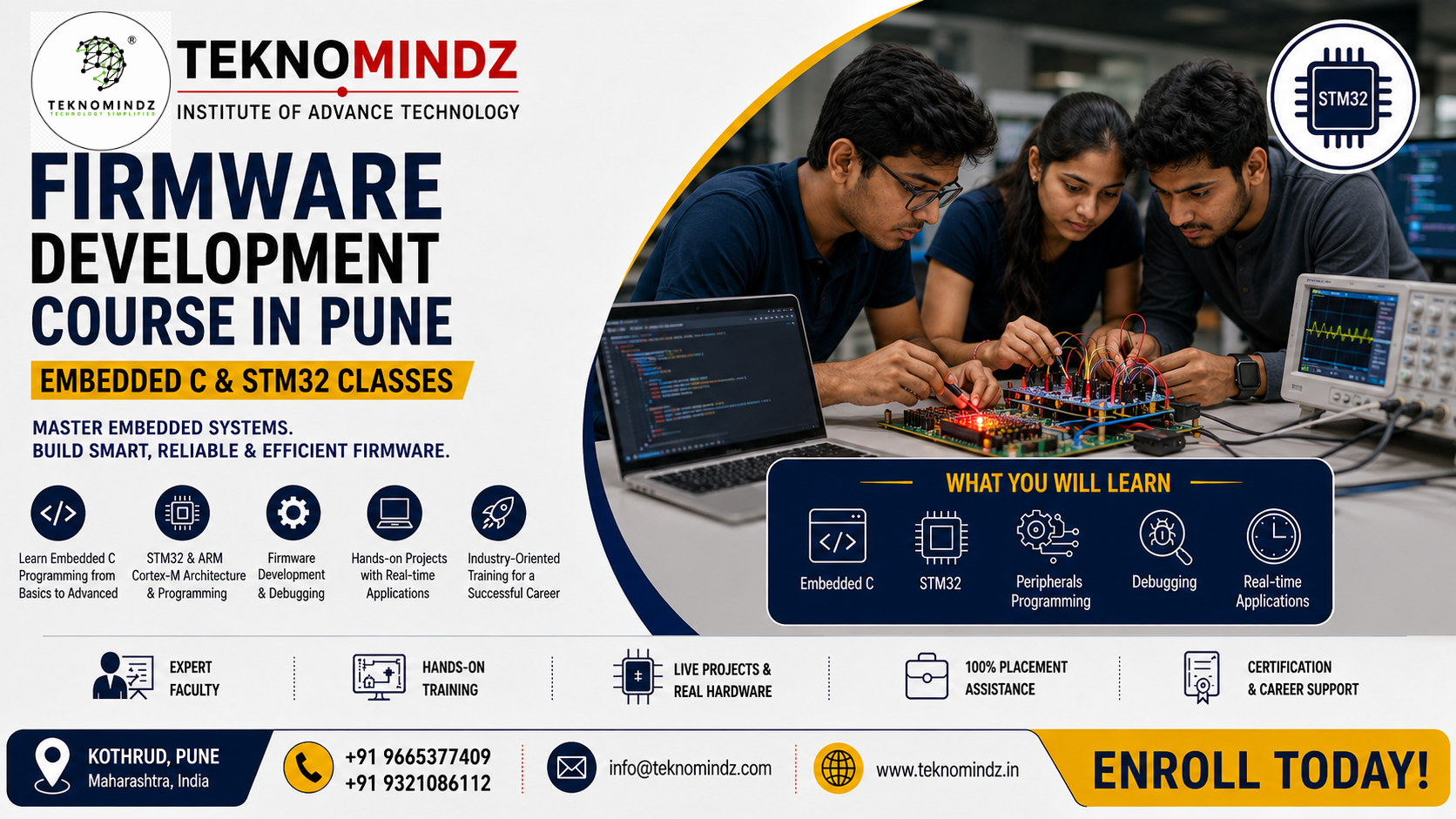
The STM32 series, powered by the ARM Cortex-M core, is the standard choice for reliable, low-power industrial control. Mastering STM32 firmware development teaches you how to write code that interacts directly with sophisticated bare-metal hardware. During our embedded training in Kothrud, you will get hands-on experience configuration complex registers, utilizing Direct Memory Access (DMA) for fast data movement, handling nested interrupts, and working with advanced hardware communication timers.
When Pune automotive component manufacturers hire firmware engineers, they look for candidates who can configure an ARM-based microcontroller from scratch without relying on basic Arduino abstractions. That is exactly what our advanced syllabus covers.
ESP32: The Backbone of Wireless Smart Tech
If the STM32 represents raw processing reliability, the ESP32 is the standard for connectivity. Featuring dual-core processing along with integrated Wi-Fi and Bluetooth Low Energy (BLE), the ESP32 is used globally to power connected smart devices.
Through our comprehensive IoT and PCB design course Pune, you will build actual web clients, configure secure MQTT connections to cloud brokers, and write multi-threaded scripts using FreeRTOS to manage multiple sensors at once.
Integrated Learning: Code, Layout, and Hardware Deployment
Knowing how to write code for a 32-bit chip is only half the battle. If you do not know how to design the physical hardware platform that hosts it, your system design skills remain incomplete. Our curriculum links firmware programming directly with physical hardware layout:
- Schematic Creation: Learn how to properly trace power supply rails, add decoupling capacitors, and connect pins for high-speed 32-bit chips.
- High-Speed PCB Design: Handle physical layout challenges, trace routing, and minimize electronic noise to keep your hardware stable.
- Physical Hardware Debugging: Work with physical logic analyzers, hardware debuggers, and oscilloscopes inside our Kothrud lab to fix real circuit bugs.
Summary: Choose an Advanced Embedded Systems Syllabus
The training you select dictates the types of jobs you can apply for after graduation. Choosing a program that relies on outdated microcontrollers limits your options to legacy maintenance roles. Learning 32-bit system architecture prepares you for roles in high-growth industries like Electric Vehicles (EVs), robotics, smart automation, and wireless product development.
Our practical training program at Teknomindz provides the dedicated lab space, individual hardware development kits, and professional guidance needed to help you become a capable hardware and firmware design engineer.